
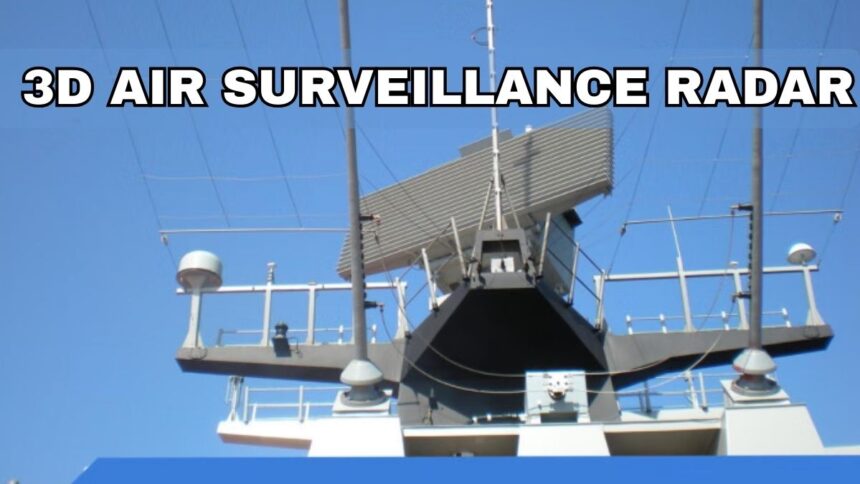
Modern defence relies on 3D Air Surveillance Radar, which can detect and track airborne targets in three dimensions range, direction, and altitude providing situational awareness far beyond 2D radar systems. Airspace supremacy determines national power. 3D radar improved fighter jet guiding, missile interception reactions, border and strategic airspace monitoring, and air security by measuring elevation in real time. It now covers commercial airliners, high-speed hostile aircraft, stealth drones, hypersonic threats, and unidentified aerial objects for global militaries, civil aviation authorities, maritime and coastal security, and space surveillance networks. You may learn everything about this beast in this article.

3D Air Surveillance Radar
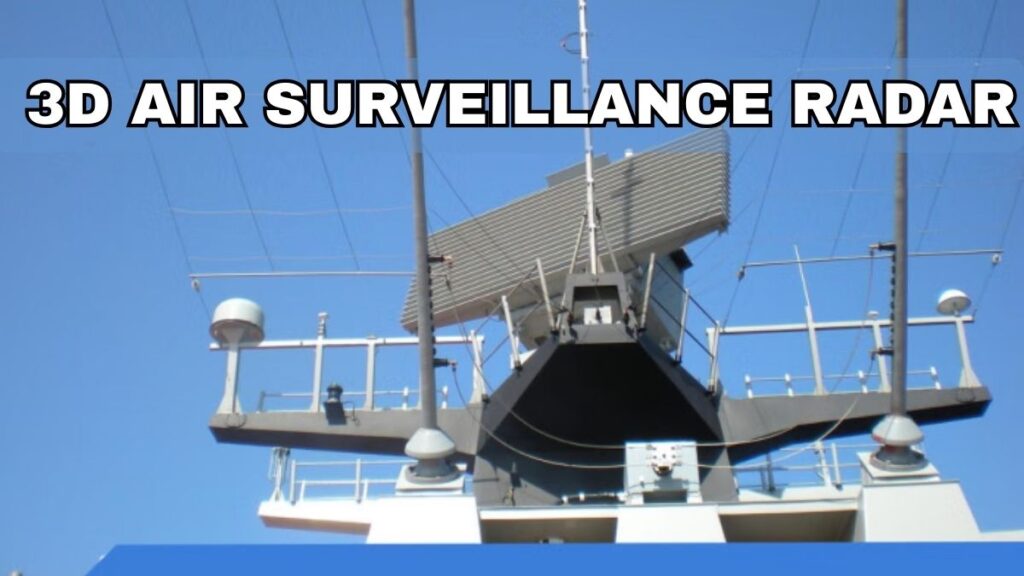
The 3D Air Surveillance Radar can simultaneously detect, track and identify air targets in range, azimuth and elevation. This enables it to sense distance, direction and height. Elevation estimation was a challenge for 2D radars; many systems were necessary and reaction time was slow.
3D radar consolidates all coordinates from a single scan, providing commanders with complete visual awareness and the ability to make decisions in seconds. The results are faster interception of targets, better border defence and more effective air traffic control.

Three- Dimensional ASR: Overview
| Name Of Beast | 3D Air Surveillance Radar |
| Advantages | Height data allows faster and more accurate air threat assessment than 2D radar. |
| Function | Aerial, drone, missile, and UFO monitoring and classification in real time. |
| Operating Principal | Detected via phased-array antenna, pulse-Doppler, and electronic beam steering. |
| Target | Modern systems can track targets up to 400–500 km or more. |
| Use | Defence, fighter vectoring, missile interception guidance, border and airspace security, early warning. |
| Civil Use | Air traffic control, space surveillance, coastline monitoring, disaster response, and search. |
| Weakness | High cost, complex maintenance, requires skilled operators, vulnerable to stealth technologies. |
How Does 3D Radar Work?
3D Radars Pulse-Doppler, electronic beam steering, phased-array antennas, and advanced signal processing. It releases high-frequency electromagnetic waves into the atmosphere. These waves return to the receiver after hitting a plane or flying object. Radar decodes through extensive mathematical modeling and wave analysis:
- Distance is measured by time of return
- Direction by antenna signal phase
- Altitude by scanning elevation beams at various angles.

All this happens millions of times every second. Modern AI aids danger recognition, lowers false alarms, and tracks even in bad weather, jamming, or stealth situations.
Key Features of 3D ASR
A phased-array antenna system allows quick electrical beam guiding without mechanical rotation.

Pulse-Doppler Processing: Advanced frequency shift analysis distinguishes moving objects from background signals.
Real-Time Threat Classification: AI detects airplanes, UAVs, missiles, and abnormalities.

Long-ranged Detection: The modern systems can even detect the targets at ranges over 400–500 km.
All-weather Use: It can be used even in downpour, fog, sandstorm or electromagnetic interference.
Network-Centric Integration: Can connect to satellites, combat aircraft, air defence missiles and command posts.
Why Does 3D Surveillance Radar Matters?
Air Defence is about seconds. If threats cannot be detected early enough by radars, there may not be time to respond. This is where 3D radar matters. It offers:
- Identification of approaching aircraft or missiles
- Precise altitude determination for interception planning
- Hundreds of targets being simultaneously tracked
- Ground-based air defence systems with better command and control.
- Superior performance in signal-jammed hostiles
Air Power In the wars of today, it is air power that plays a greater role than ever. Stealth fighters, hypersonic missiles, UAV swarms and cruise weapons fly faster than older systems can hope to track. In 3D radar, the precision of the detection is preserved even when targets fly low to the ground or at high speed, turn sharply as well infinitely valuable for national security.
3D Air Surveillance Radar–Challenges and Limitations
3D Radars New frontier Costly to develop, maintain, and operate. They require high-energy transmitters, skilled labor, cybersecurity and room on a large installation site. Defence companies need to work on multi-band and quantum-enhanced radar systems because stealth techniques such as radar-absorbent coatings reduce detection. Another issue is electronic warfare. Enemy forces may jam radar, blind targets with electronic noise, or utilize low-observable drones to hide. To combat this, modern radar includes:
- Anti-jamming frequency hopping
- AESA arrays
- Passive radar networks
- AI-based anomaly detection
Future of 3D Air Surveillance Radar
The age of AI-driven multi-band network-fused radar ecosystems is on the way. Satellites will talk to drones and high-altitude platforms and autonomous defense AI. Hypersonic missiles would need detection and predictive tracking in microseconds, pushing radar capabilities.
Quantum radar studies offer an unambiguous detection of stealth aircraft. Satellite radars could soon give us worldwide monitoring. With battle shifting into the air, radar technology is getting faster, sharper and smarter.
FAQ’s On 3D Air Surveillance Radar
- What is the difference between 3D radar and 2D?
- It also can deliver spatial tracking including altitude hold mode.
- Why radar altitude is so important?
- This assists to determine the intercept or routing level.
- The primary 3D surveillance radar user?
- Civil aviation, space observation and military air defence.
- Which targets can 3D radar track?
- UFOs, drones, helicopters, ICBMs and planes.
- 3D radars usually detect at which range?
- Sensors today can see things 400–500 miles away.
- Does weather impact 3D radar?
- Advanced systems operate with high reliability year-round with minimum disturbance.
- Can 3D radars see low-flying aircraft?
- Yes, altitude scanning does warn of low-level penetrations.