

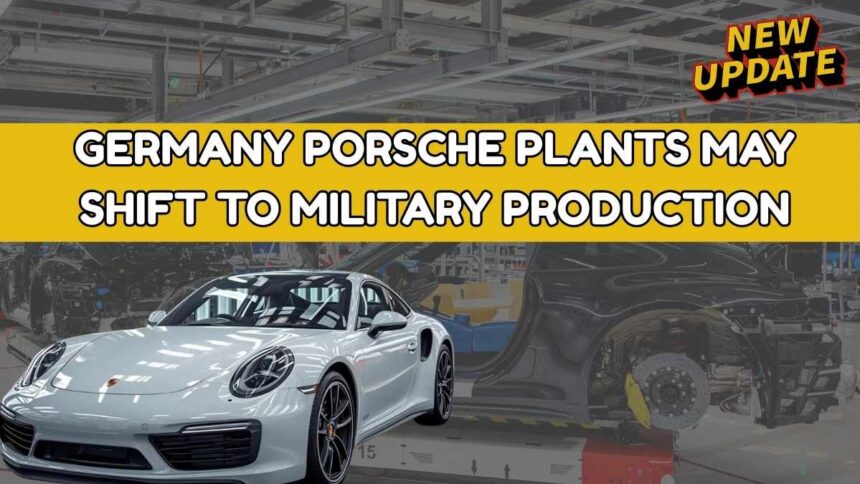
The German Luxury Car manufacturer Porsche is reportedly evaluating a strategic change towards the production of tanks and armaments, as the company encounters significant financial challenges within the automotive industry. This potential transition is incited by Germany’s ambitious plans for defence spending and a record loss of 20 billion euros projected for 2024.
- Porsche Plants In Germany May Shift To Military Production Amid Economic Challenges
- What motivates manufacturers’ shift to the military sector?
- What Does the Shift to Military Production Really Mean?
- Controversy behind the shift
- Porsche Plants In Germany May Shift To Military Production Amid Economic Challenges–FACT CHECK
- FAQ’s On Porsche Plants In Germany May Shift To Military Production Amid Economic Challenges

Porsche’s management has indicated that the financial pressures coming from a slow automotive market, along with the difficulties posed by high energy prices, reduced incentives for electric vehicles, and intensified competition from Chinese electric vehicle producers, have contributed to this decision.
Porsche Plants In Germany May Shift To Military Production Amid Economic Challenges
Porsche initiated its participation in tank manufacturing in the late 1930s and early 1940s, as a component of Germany’s military expansion before and throughout World War II. Ferdinand Porsche, the founder of the company, was solicited by the German military to create sophisticated armoured vehicles.

The possibility of Porsche re-entering the defence industry also brings to mind the company’s historical engagement in military production during World War II. Get more information below about the Porsche Plants In Germany May Shift To Military Production Amid Economic Challenges.
What motivates manufacturers’ shift to the military sector?
- The European Defence Industry is experiencing unprecedented demand and growth, with many nations increasing military spending. Rheinmetall AG, one of Europe’s largest defence equipment/ ammunition manufacturers, is converting some of its automotive plants into military production facilities due to high levels of demand.
- Rising production costs, increased competition (particularly from low-cost EV manufacturers in other countries), and falling profitability are having a negative effect on Porsche AG.
- Porsche SE, Porsche AG’s majority shareholder, has announced plans to further invest in defence and to explore additional investment opportunities in security issues, surveillance, sensor technologies, and similar industries.
- The conversion of some of their production on a strategic basis also creates a hedge against instability in the automotive sector.

What Does the Shift to Military Production Really Mean?
- The “shift to military production” that is being discussed by various levels of the automotive industry is still largely conceptual and/or exploratory in nature. At this time, there has been no formal announcement from Porsche that it will produce any type of military weapon systems at this time.
- The latest summary from Porsche SE regarding their plans for the defence sector indicates that they will be creating a “platform” to provide financial support to newer or smaller defence start-ups, but that does not mean that Porsche AG has made any such formal commitment to producing military weapons and systems.
- For other larger automotive companies, there has been movement by some of the larger automotive defence manufacturers (such as Rheinmetall) to establish automotive-equipment production lines in some of their former automotive manufacturing facilities for the production of defence-related equipment.
- Regarding Porsche, there have been some reports in the media, some of which are more speculative than others, regarding their automotive manufacturing facilities’ potential involvement in the production of tanks and/or missiles as part of a broader restructuring plan; however, these reports have not been confirmed by the Porsche company.
Controversy behind the shift
- Controversies and uncertainty surrounding transitioning from a luxury/sports-car manufacturer to defence manufacturing include ethical and political concerns regarding the reputation of the company in Europe, as well as a focus on stability and regulation with a civil-military boundary.
- With an auto-demand downturn forcing the pivot, there might be hope for the markets (especially EV adoption) to stabilise, thus the potential for the pivot to be temporary or to become permanent. Therefore, transitioning from one industry to another is unpredictable and high-risk.
- Reporting on the transition is often mixed between the holding company (Porsche SE) and the actual manufacturing company (Porsche AG), which has a tendency to overstate the immediacy or breadth of any transition.

Porsche Plants In Germany May Shift To Military Production Amid Economic Challenges–FACT CHECK
The shift of Porsche’s factories in Germany from the automotive sector to the creation of military equipment highlights a major shift in how Europe is approaching the industrial sector, with the decline of the automotive sector, the slowdown of EV sales, and increasing levels of defence spending due to tensions between countries around the world.
FAQ’s On Porsche Plants In Germany May Shift To Military Production Amid Economic Challenges
- What made Porsche consider moving into the defence sector?
- With decreased demand for electric vehicles, especially in China, increased costs of production, uncertainty about what will happen with the global economies, and decreased profits, the luxury automobile industry is no longer a viable business.
- Has Porsche confirmed that they will be manufacturing weapons or tanks?
- Not exactly. There have been reports in the media about Porsche possibly creating “tanks and weapons,” but as of now, Porsche has stated that they are interested in the defence technology industry.
- Are there other companies, in addition to Porsche, moving from automotive manufacturing to defence?
- Yes, many defence contractors, including Rheinmetall and Hensoldt, have been in the automotive or civilian supply chain and are repurposing manufacturing facilities to manufacture military products.
- What does this mean economically for employees and for the overall economy of Germany?
- On the one hand, the transition from automotive manufacturing to defence manufacturing could create opportunities for people who have lost their jobs due to the downturn in the automotive sector, by retraining or hiring displaced automotive workers.