
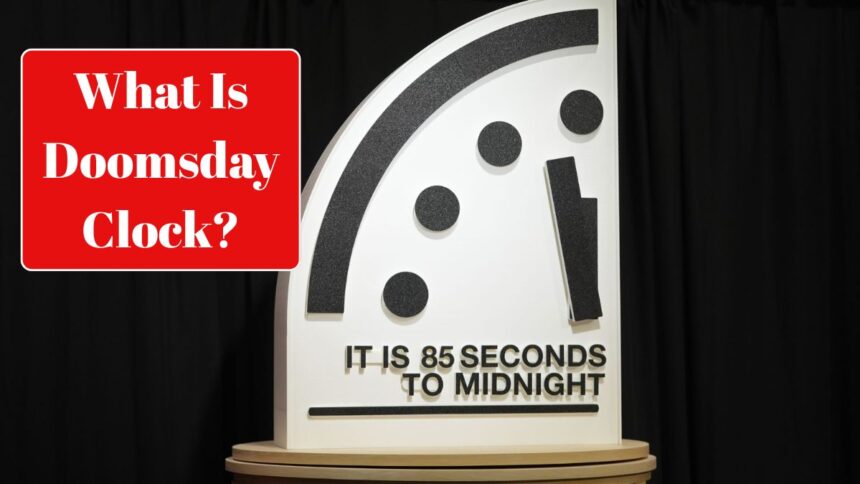
You may not think of a clock as a device that announces when to fall asleep or wake up, but it also indicates how much time an earthbound entity such as mankind has before it destroys itself, and that is what the Doomsday Clock is. For decades, the Doomsday Clock has represented a Global Risk that is ticking either closer to or further from the hour of midnight. If the clock strikes twelve, all civilisation as we know it ceases to exist.

In recent years, climate change has become a major factor in moving the Doomsday Clock closer to midnight. In addition to the nuclear threat, technological advances, and geopolitical instability, the scientific community now considers climate change as one of the major determinants of the position of the Doomsday Clock.
What Is Doomsday Clock?
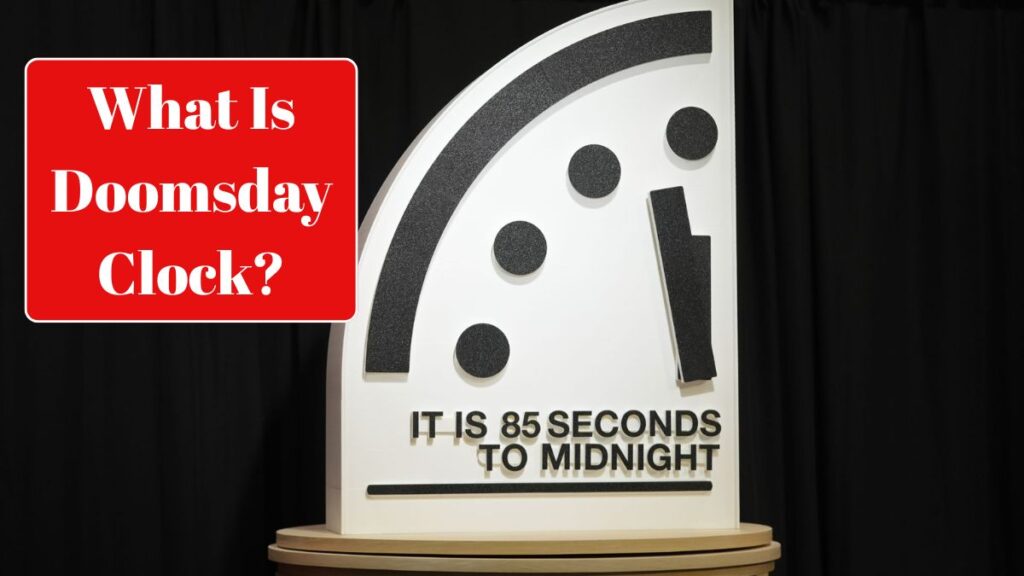
The Doomsday Clock is symbolic and indicates how close humanity is to global catastrophe. It measures how close we are to this catastrophic point at ‘midnight’ with regards to nuclear war, runaway climate collapse, or technological catastrophe. The closer to midnight that the Doomsday Clock gets, the higher the perceived risk of human extinction, i.e. when the clock is moved away from mid-night it will show improved global stability and fewer threats.

Keep in mind that the Doomsday Clock is NOT used as a means of predicting an exact date for catastrophe, but rather as a warning system, a visual metaphor that serves to create awareness, discussion, and individual action. Read below to learn more about what the Doomsday Clock, new climate threats, etc.
Who Developed the Doomsday Clock?
Established in 1947 by the Bulletin of the Atomic Scientists (a group of scientists involved in the Manhattan Project), the Doomsday Clock was created to alert the world about the dangers posed by the development of nuclear weapons and the potential negative impacts of technological advancement and poor political decisions.

In addition to nuclear threats and other forms of global risk, the Bulletin’s focus has evolved to include items such as climate change, pandemic disease, cyber warfare, and developing technologies (such as Artificial Intelligence). As a global symbol, the Doomsday Clock continues to be widely recognised and referenced by leaders, educators and media from around the globe.
How Scientists Set New Time For The Doomsday Clock?
The Doomsday Clock is maintained by the Science and Security Board for the Bulletin of the Atomic Scientists, and by a collaborative group of scientists, professionals in Climate Science, Nuclear Science, Policy Makers, Security Experts, and Nobel Prize winners.

The Science and Security Board does, however, receive guidance and advice from a group of individuals called the Board of Sponsors, which consists of many eminent scientists and world leaders.
Every year, if necessary due to events of global significance, the Science and Security Board meets to evaluate world events and make judgments based on their evaluation of how human activity is affecting the chances of a disaster occurring.

Threats occurring in the Doomsday Clock
In recent years, the clock has been moving by some seconds. As per reports, on 27th January, 2026, the clock moved to 85 seconds (1 minute, 25 seconds) before midnight. Before this, the clock on 28th January, 2025 has moved to 89 seconds (1 minute and 29 seconds) before midnight.