
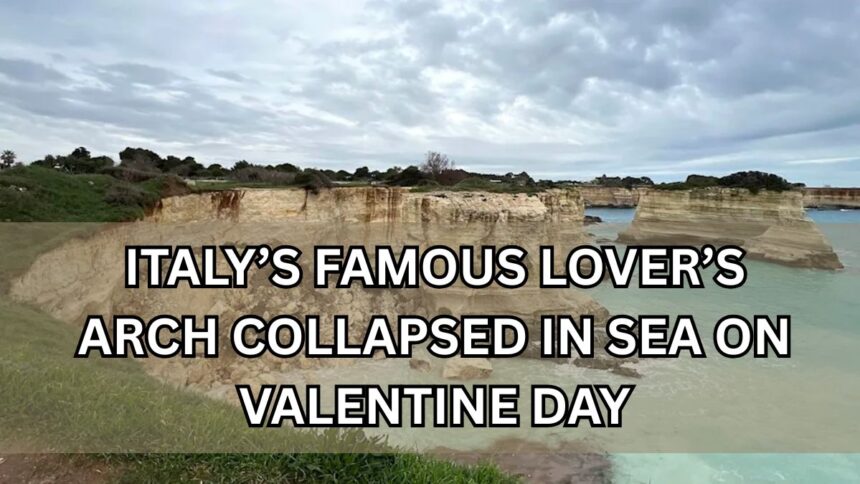
The iconic arch of the sea stacks at Sant’Andrea in Melendugno, Puglia, Italy, widely known as Lovers’ Arch, collapsed on Valentine’s Day due to powerful storm surges and heavy rain that swept through southern Italy.

This rocky arch, one of the most recognized natural landmarks on the Adriatic coast, received its name because it was a favored backdrop for wedding proposals, selfies, and postcards, and it stood as one of the most recognizable symbols of Salento, a highly frequented tourist destination in Italy.
“This is a heartbreaking loss,” remarked Maurizio Cisternino, the mayor of Melendugno. “One of the most renowned tourist attractions along our coastline and throughout Italy has vanished.”

According to local officials, the strong winds, rough seas, and heavy rainfall in recent days gradually weakened the rock structure until it ultimately collapsed on Saturday. This event represents the most significant damage caused by coastal erosion to the Salento landscape.
Italy’s Famous Lover’s Arch Collapsed
A notable rock formation known as “Lovers’ Arch” in Southern Italy collapsed on Valentine’s Day due to severe weather conditions. The powerful storm surges that resulted in heavy rain and winds over the weekend led to the fragile structure at Faraglioni di Sant’Andrea crumbling on Saturday, February 14.

This natural formation has become a key tourist attraction in Salento, found in Italy’s Puglia region, attracting thousands of tourists and couples eager to experience the stunning views of the Adriatic Sea. On Sunday morning, visitors first noticed the absence of the natural landmark, following the severe weather brought to the area by Storm Oriana.
Although Cisternino was aware that the collapse would eventually occur, the severe natural conditions brought on by the storm hastened the disaster much sooner than anticipated.

Bad Weather and Erosion Causing the Collapse
Officials said the sudden collapse to days of continuous severe weather, which included heavy rainfall, strong winds, and powerful storm surges that impacted the Salento coastline during the Valentine’s Day weekend. Meteorological disturbances, part of a series of Mediterranean cyclones affecting southern Italy in recent weeks have greatly weakened the rock formation.
Scientists and local authorities have repeatedly warned that coastal erosion is accelerating in the region, a trend intensified by rising sea temperatures and increasingly frequent extreme weather phenomena. The Lover’s Arch, resting on naturally fragile limestone, was particularly vulnerable.

Effects on Tourism and Community
The loss of the arch is expected to impact the local tourism sector, which depended on the striking natural arch and the scenic sea stacks of Torre Sant’Andrea as a primary draw. Travel guides, photographers, and couples organising romantic getaways have consistently promoted the location as an essential destination in southern Italy.
Numerous locals and tourists have voiced their shock and sorrow regarding the disappearance, perceiving the arch not merely as a geological formation but as an emblem of love, memories, and collective experiences.
Local Authorities Respond to the Loss
Local officials grieved as they announced the arch’s collapse. Mayor Maurizio Cisternino of Melendugno referred to the incident as “a devastating blow to the heart” and a significant loss for both the community and the region’s tourism image.
Puglia Governor Antonio Decaro reiterated these thoughts, expressing sorrow over the loss of one of the region’s most notable natural features and stressing the challenge of preserving Italy’s coastal heritage from increasingly severe weather conditions.
Officials also indicated that other areas of the rugged coastline, already showing clear signs of damage, could be in danger of collapse, emphasising the broader consequences of coastal erosion in the region.