

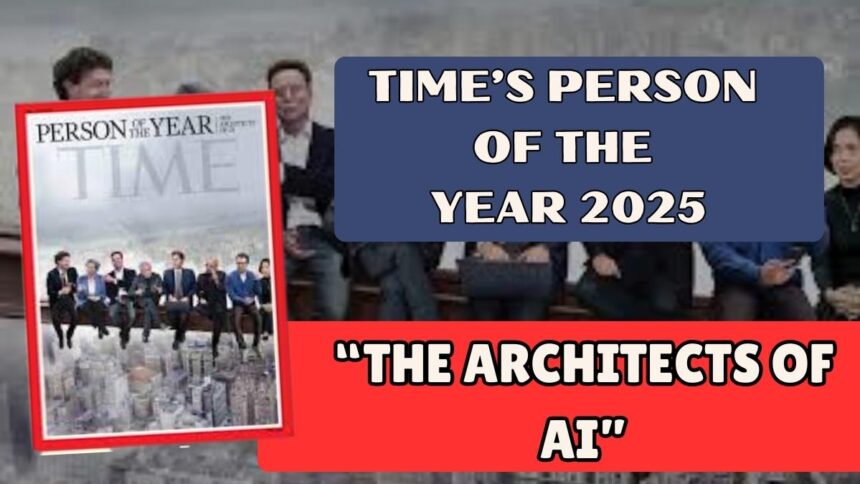
Each December, TIME Magazine announces its “Person of the Year” as part of a long-standing editorial practice spanning over 90 years. The individual(s), company(ies), organisation (s) or concepts selected as the Person of the Year have had the greatest impact on global events during the previous 12 months, positively or negatively.
- Time’s Person Of The Year 2025
- Overview of the Time’s Person Of The Year 2025
- Latest News
- Who Are the “Architects of AI”?
- AI’s Evolution in 2025
- Time’s Person Of The Year 2025–Conclusion
- FAQ’s On Time’s Person Of The Year 2025
- Who has won the title of Time’s Person of the Year for the year 2025?
- Why is AI being used so extensively in 2025?
- Are only people who have done good things recognised by being named Person of the Year?
- Have groups been designated?

The original selection was made in 1927, and since then has typically not been considered to be simply a “popularity contest” or merely an award of recognition but instead a knowledge-based analysis of who had the greatest impact on global events. For example, the Person of the Year has included historical leaders and thinkers, activist groups, etc.
Time’s Person Of The Year 2025
TIME magazine made significant changes to its Person Of The Year award in 2025, with its choice of “The Architects of AI” instead of naming an individual for the award. This year, rather than selecting one individual as Person Of The Year, TIME chose to honour the “Architects Of AI” as many people around the world continue to create, develop, improve and deploy Artificial Intelligence technologies.

By selecting the “Architects Of AI,” TIME magazine sent a clear message that AI and its applications will change our lives; no matter where we live, we will all feel the impact of AI on a global scale. 2025 marked a special milestone for AI as it proved to be more than just a new form of technology, but rather was a new frontier in business, economics, and political power in many countries.

Overview of the Time’s Person Of The Year 2025
| Title | Time’s Person Of The Year 2025 |
| Featured leaders in Time’s Person of the Year | Sam Altman, Jensen Huang, Elon Musk, Mark Zuckerberg, etc. |
| Time’s Person Of The Year 2025 | “Architects of AI” |
| Why are AIs chosen this year? | AI’s advances became widespread, shaping industries, culture, and policy debates |
| Year | 2025 |
| Category | Time’s Person Of The Year |
| Resources | https://time.com/7339685/person-of-the-year-2025-ai-architects/ |
Latest News
Time Magazine has awarded the title of “Architects of AI” as their Person of the Year for 2025, in recognition of the men and women responsible for creating and deploying AI technology, ultimately reshaping the world over the last year. The recipients of the award include some of the top leaders in the AI space as well as corporate executives who have helped to bring AI technology into the mainstream.

The reason for selecting these individuals is that AI has the potential to revolutionise medicine, manufacturing, and many other industries while causing a slew of new challenges, including disinformation, the effect on jobs, and ethical concerns. According to the editors of Time, 2025 would be viewed as the year when AI made its mark on society and could not be eradicated.
Who Are the “Architects of AI”?
Time Magazine recognised these individuals as “Architects of AI”. They each had an impact on AI development. Here are the influencers of AI who were named Time Person Of The Year:

- Sam Altman (CEO of OpenAI),
- Jensen Huang (CEO of Nvidia),
- Elon Musk (co-founder of xAI/Tesla),
- Mark Zuckerberg (CEO of Meta),
- Lisa Su (CEO of AMD),
- Demis Hassabis(CEO of Google DeepMind),
- Dario Amodei (CEO of Anthropic),
- Fei-Fei Li (Stanford University’s AI Researcher and founder of the AI Research Lab).
Time selected these people not just for their wealth or celebrity status but also for their active involvement in developing and deploying the most sophisticated types of artificial intelligence, which has changed the landscape of society dramatically.

AI’s Evolution in 2025
In a recent article from Time magazine, editors now agree that 2025 marked the time when artificial intelligence (AI) fully emerged into view; from that point forward, every facet of society cannot escape its influence or operation.
As a result of AI’s widespread impact across many sectors, including health care, finance, education, media, and national security, these sectors will continue to be transformed in many ways based on how people perform their jobs and how they make decisions.
Both the cover and article cover advancements through breakthroughs (i.e., breakthroughs in medicine, increases in productivity from the ability to automate) to as the serious concerns that come with advancements through breakthroughs (i.e., misinformation, ethical issues, displacement of jobs, and lack of clarity regarding regulation).
Time’s Person Of The Year 2025–Conclusion
TIME Magazine has named the “Architects of A.I.” as its 2025 Person of the Year to symbolise one of the most significant turning points in our history, when A.I. went from being an area of promising research to becoming an actual global presence. It honours every individual involved in the quick emergence of A.I. and recognises the tremendous impact of A.I. on society and every person’s life.
FAQ’s On Time’s Person Of The Year 2025
Who has won the title of Time’s Person of the Year for the year 2025?
The “Architects of AI” have created technology for artificial intelligence.
Why is AI being used so extensively in 2025?
In 2025, advances in artificial intelligence influenced nearly every aspect of society, including business, lifestyle, and governance.
Are only people who have done good things recognised by being named Person of the Year?
No. The Person of the Year designation reflects the individual or group that has had the greatest impact on society, regardless of whether their actions were viewed as good or bad.
Have groups been designated?
Yes, Time has designated groups or concepts as a Person of the Year in very limited circumstances, such as the personal computer (1982) and Endangered Earth (1988).